Recently I was struck by Valencia Cagiano’s posts about her marriage breakup. She has video-blogged frequently about her life, marriage, and 4 kids, over the past 12 years.[i] Valencia, or “V”, is funny! She could be a stand-up comedian. She is a gifted singer who shares original Hip Hop and worship songs[ii]. While at times she shares her Christian beliefs, her profiles do not mention faith. Her video-blog is personal. Viewers watch her life change, to include pregnancy with twins, discovery of her Army spouse’s infidelity, and moving out to begin the journey of a single mom living with parents. She shares recipes, advice, insights into custody battles, and spoke about the challenge parenting during was during COVID19.[iii] She refers to viewers as “besties” and focuses on fellow mothers and women when addressing her 92.2K YouTube subscribers. Her vlogs have 22 million views.
The vlog episode I want to focus on was uploaded in 2015. V titled it, “True Story: Leaving My Husband.” In the vlog she tells about leaving her Army spouse, James (Jim), after his repeatedly cheating. [iv] She was 30 years old, and explains that she was faithful in the relationship. Now living with their children at her parents’ home in Jacksonville, FL, V is experiencing partial vision impairment in her left eye. V is black and her husband is white. Their children are young. They have 21 month-old twins–a boy and girl–and two older boys, age 7 & 10. Jim is an enlisted Soldier (E-4) who joined the Army at age 28. Valencia does not have a job outside full-time parenting.[v] Below is a redacted script from V’s 43 minute vlog.[vi]
“Girl, I’m telling you, he had a “Lord Voldemort” spirit. But when I said “I do,” I wanted it to mean something. My husband was white but what happened didn’t have to do with race, it could happen to anyone. The “Cheater Mate” will make it feel like it’s your fault, that you aren’t enough. Sisters, let me tell you that if you are married and the same religion, go to church together. Go to marriage counseling. Pray at nighttime together before bed, say grace together.” When you make vows, you are “saying ‘I Do’ to the human experience together, but some people don’t know how to honor those vows for better or worse. I was in a relationship in which I was always the fixer. He would let 3-4 days go by of not talking to me unless I broke the ice. I’m not the type of person that wants to take things from anyone…Would you believe it, when I drove home to pick up a few things—and took hardly anything, just a couple TVs and some clothes, he showed up to make his presence known with his Army friends…Thank God I left the kids with mom. He didn’t even ask to see them and acted like the two TVs were too much. He was cheating on lunch breaks. Parties were going on at the house. Our family pictures would be put away, my things shoved in the closet… You know I’m praying about a lot of things. I don’t want to claim anything negative over my life. But I had to go when I realized that it was ‘all about him’…never about me or the children. And I didn’t want the children to grow up with a father like that. I know I have post-partum issues. I’m gonna change my diet for the better. I want to focus on getting my Spirit back healthy. (At this point her voice trails off singing Janet Jackson’s “Like a moth to a flame, burned by the fire, that’s the way love is.) You know to be well you have to be careful about how you think, not focusing on him. Stress can kill you! I know there were times I struggled to keep on living. At the end of the day, the only thing you can have sometimes is to have a peace about situations. I fear being solely responsible for my children. I’m a full-time parent. I’m so ready to be unafraid of the future. So now, what do I care about most? Family is first, and all that matters is not being afraid.”
PART 2: REFLECTIONS ABOUT “V’s” Life and Story. It would be hard to understand V and her family -as a Chaplain, or pastor- without considering some of the inherent challenges in her life at the time of her post, poverty, racial inequalities, and her status as a military dependent.
V’s family had been living on the poverty line. Her husband’s wages put them below the poverty level in 2015. In 2015 Jim was likely a Specialist (E-4) and earned $2,350 per month.[vii] The poverty level for a family of six in 2015 was $31,670. They earned $28,200. [viii] One factor which helped their finances was the Army’s additional Basic Allowance for Housing (BAH), which added $1479.00 to their monthly income. If they lived in military housing, they did not receive that BAH as potential additional income.[ix] Without doubt her decision to leave, with limited income and employment options as a single black mother, showed courage.
It is important to mention V’s race and inequality structures. As a black American, one of those issues relates to housing. Chanequa Walker-Barnes explains how the FHA “practice of undermining sales by under appraising homes in established neighborhoods” happens to people of color disproportionately.[x] V’s circumstances led to a hard question, where would she and the four children live? Would they get stuck in poverty? Would she be able to buy a home, or rent in a safe neighborhood with a good school district?
Pastoral theologian Walker-Barnes has written about the “StrongBlackWoman” (SBW) paradigm. V’s story demonstrates various beliefs, some likely unconsciously held, to include her expectations and society’s, reminiscent of dangerous aspects of the SBW. In a lecture, Bioethics and the Underserved, Dr. Richard Payne spoke about the ironic outcome of the SBW’s suffering, that “because of their great strength, they suffer enormously.”[xi] V demonstrates many of these tendencies. She works extremely hard as a vlogger to provide for her children, but it is a hard way to earn money. And painfully public. She manifests physical symptoms of pain due to the stress that she carries, her left eye no longer functions properly. Of being independent, she explains, “I’m not the type of person that wants to take things from anyone.” She leaves the home with hardly any belongings due her. In the relationship, she is the “Fixer.” Her husband will do the silent treatment for 3-4 days, until she breaks the ice. Ultimately it is for her children’s welfare that she leaves. The repeated infidelity signals to her, that ultimately he will not be the kind of father her children need, –one that puts their needs above his own.
Other characteristics of the SBW are V’s vibrant Christian spirituality, her empathetic advice-giving to other women—, and lastly that she does not show any tears in the 43 minute blog. This lack of emotion portrays the SBW who seems able to withstand anything.[xii] The result of acting out this myth is a “multi-tasking” and “overcommitment” that makes women like V into “a modern day Atlas bearing the weight of the world on her shoulders.” [xiii] Debilitating impacts on her physical health are likely to come without intervention. “Black women are experiencing epidemic rates of medical conditions such as… diabetes (&) hypertension…and they have higher morbidity and mortality rates than any other racial-gender group for nearly every major cause of death.” [xiv] Here we have a mother of 4 children, 2 of the babies under the age of two, who says “I fear being solely responsible for my children.” As a full-time parent she wonders how she will provide for them, but remains determined to make a way. There is not a hint of giving up.
Another challenge for V is that her support network is now threatened by the choice to leave her military husband. Her access to health care, base-housing, shopping at the Exchange, the Commissary, using on-post childcare (more reliable, less expensive and higher quality) and gaining legal support, counselors, chaplains and clinical social workers hinges on her status as a “military-dependent.” While she technically qualifies for these benefits while still married, once divorced, she will lose her base access, and her medical care. Meeting the needs of her children through the old-support network will be nearly impossible. Military spouses understand this, and it is a factor that makes it harder to leave. [xv] Were V receiving the benefit of on-post childcare, its cost is fixed. In 2015-16 it was $386 per month per child for CAT 3 income military families like the Cagianos. For $1158 a month[xvi], Valencia could put her youngest three into a safe childcare in order to work or pursue a degree. This benefit, available at military bases, would go away were she to divorce and gain 51% custody. [xvii] The costs savings are dramatic. The current cost of childcare in Virginia is $600-1200 per month per child. [xviii] During her marriage V was also likely at an employment disadvantage due to “long absences of the service member, childcare difficulties, and (spouses’ perception of) the stigmatization of military spouses by civilian employers.” A study found that military spouses were less likely to be employed and to earn less than their civilian counterparts. [xix]
I do not know if V’s husband ever deployed or had PTSD. This would be helpful to know as the presence of PTSD negatively impacts marital satisfaction.[xx] Even in the absence of PTSD, higher stress, and greater frequency of depression have been shown. We know that V experienced periods of job-related separation from Jim while with the four children.[xxi] Army deployments in 2012 were regulated to shift down to 9 months long, unlike the 12-18 month deployments of the first 10 years of the war on terror.[xxii] Living under the shadow of separation and deployment places a toll on military families, and pressurized the Cagianos.
V’s marriage was to a man who was White. A 2009 study on divorce among interracial couples showed that such marriage did not translate to higher divorce rates than other pairings in society. [xxiii] V says that she did not view her husband’s choice of infidelity to relate to race. According to the study mentioned, interracial marriages involving blacks were less stable than other interracial marriages.[xxiv] V was a Black military spouse and mother who was dependent on her husband’s income and military benefits for her family’s welfare. Why did he break trust with her? Was it mere failure of integrity, or was there abuse that grew from a deeper level of bias?
A final factor relates to V’s recent birth of twins. Multiple births have been shown to put parents at greater risk of postpartum depression. V acknowledges postpartum struggles with anxiety in her vlog.[xxv] Pastoral caregivers might ask, did V or Jim ever get help for anxiety, and depression? They added, to already full lives, two more babies at the same time. This is not to excuse Jim’s infidelity, or to oversimplify V’s struggles but it is to recognize a a factor putting their mental health at risk. Postpartum parenting likely strained Jim’s life,[xxvi] and his being an older active-duty junior enlisted Soldier (31-years-old at the time of their split), probably contributed to depression and poor decision making. [xxvii] Psychologists researching postpartum have recommended giving special focused care to affected parents.
Part 3: Hypothetical Context for Support: In this section, I want to imagine what care for Valencia and her husband could look like, and then apply that to how a chaplain or caregiver could support them.
“V” and her husband attend the military chapel that I pastor in Fort Eustis, VA. I am not the chaplain of her husband’s unit, but I am the deputy-post chaplain with monthly contact with the Post’s Command Leaders. She asks to meet on Monday afternoon at the chapel, the day she returns to pick up her things and complete her move-out from Jim. During a lengthy phone call from her parents’ home in Jacksonville, FL, she has explained that she is leaving Jim due to his repeated cheating. The presenting issue with V is marital separation due to infidelity. As a pastoral giver, my response to V is important. She has opened up sacred space to speak to me as a minister and as the first military authority made aware of the situation. After our phone call, I prioritize my concerns for her: 1. Safety 2. Material welfare of her and the children, 3. Her spiritual welfare, 4. Navigating the military support system 5. Her husband’s safety. (In real-life I do not know Jim or Valencia.)
Physical Safety. I want to ensure that when V returns to pick up her belongings, she is physically safe. To protect the service member, and out of fear, many spouses avoid speaking to a Soldier’s command about infidelity and marital problems. But by failing to do so, they may unnecessarily endanger themselves. In her initial phone call to me, I did not address the safety concern, but the following day I call to ask if she had considered contacting Jim’s leadership. While doing so might inflame Jim’s anger, it brings the situation to the command’s awareness and allows them to support V and Jim individually. It might also lead to a military protective order (MPO) to keep him from the home, while V collects items that Monday morning. [xxviii]
Material Welfare. V shared her fear of becoming “solely responsible for my children.” Many practical issues confront her. Does she have money? Does she need legal support? Does she need childcare? I would plan to call and explain to her before our meeting that as an Army Spouse she and the children are entitled to resources in Jacksonville at the Naval Air Station: medical care, counseling, chaplain, commissary, clinical social workers, and some legal support.[xxix] V has shared about her incapacitating anxiety and blurred vision. Due to these acute concerns I want her to access care soonest.[xxx]
Church Solidarity. When V arrives to the office, my focus is to listen well. My hope is to assess her spiritual and emotional welfare, and build her up. I want to affirm the courage and rightness behind her decision to leave. I do not want her to blame herself for what has happened. I may tell her that the Christian community at the chapel, while not aware of the details, have expressed that they are praying for her, and miss her family. It could fortify her to know that her church family loves and stands beside her.
Spiritual Welfare. In the case study text, V brings up strong feelings about her sense of worth being wounded by Jim’s cheating and treatment of her. She wants to stop feeling so afraid about the future. V’s feeling of betrayal[xxxi] could lead to strong bitterness toward Jim. She has referred to him as a “Cheater” and as a “Lord Voldemort.” Voldemort is known in the Harry Potter series for cruelty, torture, being a liar and sadist.[xxxii] It may be too early to talk to V in depth about forgiveness, or overcoming bitterness, and other aspects of divorce recovery. [xxxiii] But I do want to listen to how she is responding to the grief and anger and point her to God’s unfailing love and protection. Aware that her vlog is public, V’s sharing the private issues in her life might have unintended consequences on her children, her heart and on Jim. This medium could become a vehicle for bitterness, attack and triangulation (should she hope that Jim will view it) that would hurt her soul. Asking her what might be life-giving vs. life-limiting regarding vlog content might be a helpful lens to help her consider how she uses it. A delicate issue that might come up is marriage restoration. I have not heard Jim’s story[xxxiv], and although he attends the chapel, V is my priority. She has reached out to me and she is in the vulnerable position. If she asks whether they should meet alone together, I would recommend their meeting, instead, with me at the chapel.
CONCLUSION. As I look to help V consider her hope, I will ask her how she envisions her future story in a best case scenario.[xxxv] In the midst of pain she spoke of God’s goodness and said she was grateful for her children, parents and the safe place they’ve provided her to live. Asking her to share more about this gratitude might be another avenue to hear about her story. I hope she will feel safe to speak about the feelings of pain and betrayal too, and theological struggles she might have glossed over in the Vlog. While V wants to be strong and independent, it might help to bring to her attention the dangers of uncritically requiring of herself the SBW paradigm. V is deserving of justice, of grace and self-compassion. With this in mind, I would encourage V to allow her family, the body of Christ, and God to help carry her in this heartbreaking season. [xxxvi]
It is possible that I may still not understand what V needs most. Perhaps she will express anger at the church or at God. She might “no-show” the scheduled Monday meeting. She could reveal something unexpected–that she wants to mend the marriage. I need to rely on the Holy Spirit. While I deeply want to help her, what I bring will not be enough. But God who cares much more, can sustain her. I think of the paralytic’s friends who lower him through the roof to Jesus. For all V has been through, she should be laid out flat: daily care for twin babies, undeserved infidelity, losing her home, having to move 600 miles, her lost years of professional progress; and the coming challenges of single parenthood, legal adjudications and loss of community. But God is the burden bearer. Jesus bore the cross for her and is Healer. God’s eye is on V and on her children. God will never fail, leave or forsake her. With this in my heart, I would ask Valencia if she would like to pray, and then together ask God to provide, to keep V in peace and to fill her future with the fearlessness that she seeks. In God’s perfect Love her fear can be cast aside again and again.
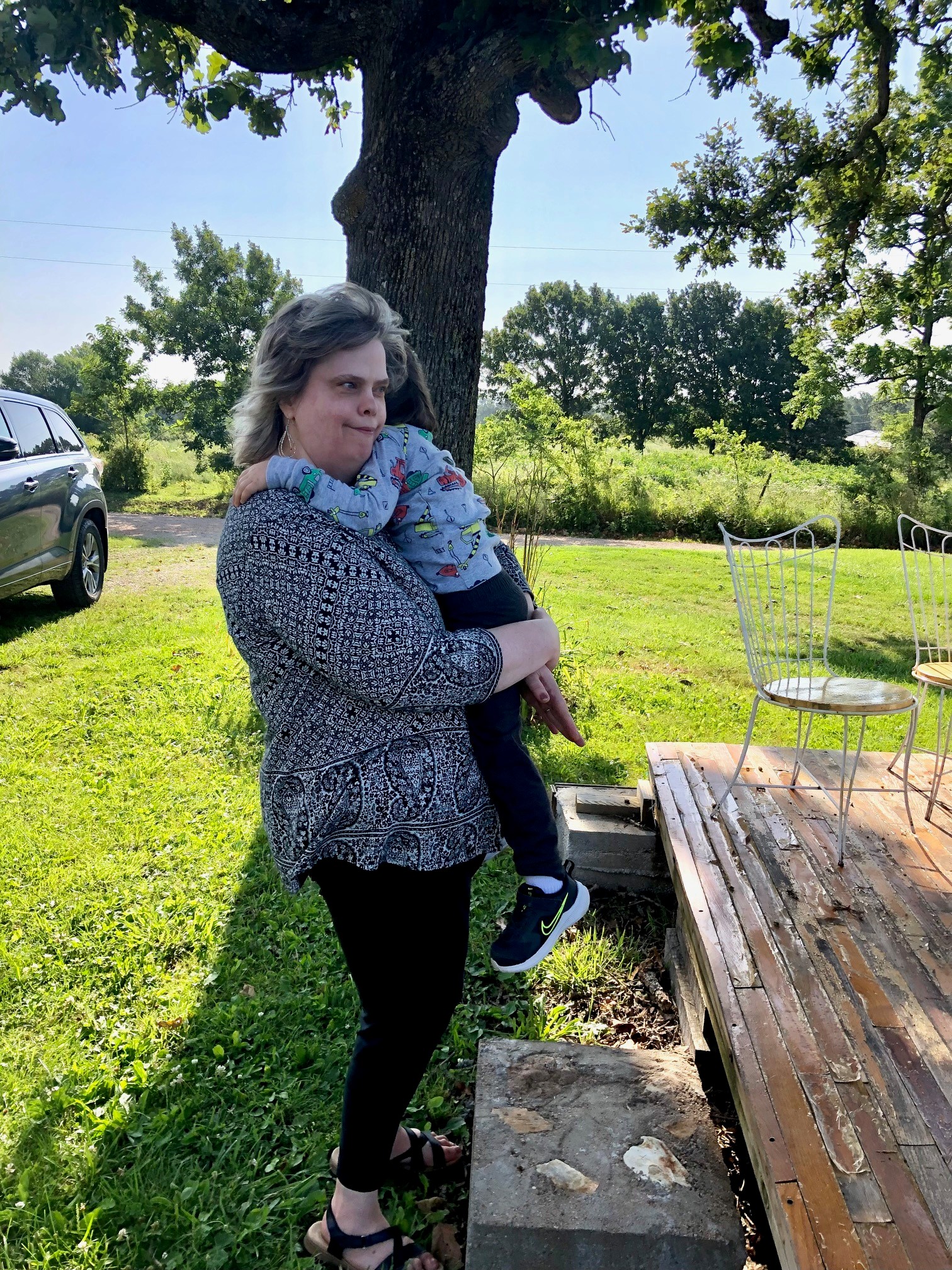
Appendix: Pictures of Valencia and Family
[i] Valencia has uploaded 1337 videos on YouTube (approximately 2-3 posts per week) and has 16.6K followers on Instagram. https://socialblade.com/youtube/user/productjunkiexoxo/monthly. Accessed 6 NOV 2020. Valencia’s monthly earnings on YouTube range from 20-320 dollars. Over 10 years her total earnings are somewhere between $5k to 80K https://www.celeb-networth.com/productjunkiexoxo The point is that she has not earned a living wage, despite having 20 million views. Accessed 6 NOV 2020.
[ii] Cagiano, Valencia. Published, 23 JUN 2016. “Hard Way” is the story of her breakup in song form. https://www.youtube.com/watch?v=AZMHz8-nINQ Accessed 6 NOV 2020.
[iii] She describes herself as a “funny mommy vlogger” who shares her ‘unfiltered life.” And explains that she is “a very spirited person” sometimes “a tad bit dramatic.”
[iv] Valencia has 4 children, the twins were born @ DEC 2013 and in 2020, will soon be 7, the older boys are 10 and 13. Names from oldest to youngest: Jordan, Israel, Jullian and Max.
[v] In a different episode, before their marital problems, the couple shared how they first met. Both were waiting in line to buy food at “Chick Fil A.” At the time Jim was doing entry-level marketing for a company contracted by Disney.
[vi] Cagiano, Valencia. Published 22 OCT 2015. “True Story: Leaving My Husband.” https://www.youtube.com/watch?v=S4wI5WxjeBo Accessed 6 NOV.
[vii] As an E-4 with 3 years in service, this is what Jim would have earned in 2015. https://www.militaryrates.com/military-pay-charts-e1_e5_2015 Accessed 7 NOV 2020.
[viii] https://www.census.gov/data/tables/time-series/demo/income-poverty/historical-poverty-thresholds.html Accessed 6 NOV 2020. Jim was a Sergeant (E-5) when he separated from the Army in 2018.
[ix] https://www.militaryrates.com/military-pay-bah-rates_2015?state=VIRGINIA&mha=VA297
Accessed 6 NOV 2020.
[x] Walker-Barnes, Chanequa. I Bring The Voices of My People: A Womanist Vision for Racial Reconciliation. (Grand Rapids, MI: Eerdmans, 2019), p. 45.
[xi] Payne, Richard. In a 4 NOV 2020 Class Lecture at Duke Divinity School, Dr. Patrick Smith shared a 2011 clip of Dr. Payne’s Flanigan Lecture address to Physicians, Ethicists and Theologians at the Center for Practical Bioethics in Kansas City. In the lecture he brought up the StrongBlackWoman and the counterpart myth, John Henry, and their suffering at the end of life.
[xii] Walker-Barnes, Chanequa. Too Heavy a Yoke: Black Women and the Burden of Strength. (Eugene, OR: Wipf & Stock Publishers, 2014), p. 4. In her text she defines the archetype the StrongBlackWoman. It is “a particular, and fixed, way of being in the world. It is a racialized gender performance, a scripted role into which Black women are socialized, usually beginning in childhood. Rather than being a genuine expression of personality, it is a mask that stifles authenticity, subsuming multifaceted selves behind a singular wall of self-sacrifice and emotional stoicism. The StrongBlackWoman is at once an archetype, a performance, and an ideology. It is, in effect, the hegemonic black femininity.”
[xiii] Ibid. p. 4.
[xiv][xiv] Ibid. p. 5.
[xv] Van Slyke, Ryan D., and Nicholas J. Armstrong. “Communities Serve: A Systematic Review of Need Assessments on U.S. Veteran and Military-Connected Populations.” Armed Forces & Society 46, no. 4 (October 2020): 564–94. https://doi.org/10.1177/0095327X19845030.
[xvi] MyArmyOneSource.com file:///C:/Users/Kristian%20Carlson/Downloads/Final_SY15-16_FeeCharts_Oct15V2.pdf Accessed 7 NOV 2020.
[xvii] See Military.com https://www.military.com/spouse/military-benefits/questions-benefits-getting-divorced-what-military-benefits-kids.html Accessed 7 NOV 2020.
[xviii] Economic Policy Institute “The Cost of Childcare in Virginia” https://www.epi.org/child-care-costs-in-the-united-states/#/VA Accessed 7 NOV 2020.
[xix] Ross, S.M. 21st Century American Military Families: A Review in the Context of the Wars in Afghanistan and Iraq. Sociology Compass, (2014) 8: 888-902. doi:10.1111/soc4.12168
[xx] Ibid. pg. 894.
[xxi] According to one Vlog post, Jim was away for military duties from 16 SEP to 16 OCT 2014. https://youtu.be/zG3ksrrwxcc Accessed 7 NOV 2020.
[xxii] Typical Army deployments during V’s marriage to her husband had shifted to 9 months. It is unknown if he deployed while they were at Fort Eustis, VA. https://www.army.mil/article/63073/soldiers_to_begin_2012_with_nine_month_deployments
[xxiii] Zhang, Y., & Van Hook, J. Marital dissolution among interracial couples. Journal of Marriage and the Family, (2009), 71(1), 95-107. Retrieved from https://login.proxy.lib.duke.edu/login?url=https://www-proquest-com.proxy.lib.duke.edu/docview/1826600783?accountid=10598 pg. 104.
[xxiv] Ibid. “Research in communication and cultural studies found that social pressures tend to increase social isolation of Black-White unions, especially from the White community, and consequently negatively impact the survival of these marriages.”
[xxv] Landau, Elizabeth. “Multiple births increase risk of postpartum depression.” CNN.com March 31, 2009. https://www.cnn.com/2009/HEALTH/03/31/depression.multiple.births/index.html?iref=nextin Accessed 7 NOV 2020.
[xxvi] Wenze, S. J., Battle, C. L., & Tezanos, K. M. Raising multiples: mental health of mothers and fathers in early parenthood. Archives of women’s mental health, 18(2), (2015) 163–176. https://doi.org/10.1007/s00737-014-0484-x “Due to a multitude of factors, including increased demands of caring for multiple (often preterm) infants, greater sleep deprivation and sleep interruption, higher financial burden, social isolation, more prenatal medical involvement and physical discomfort, and greater role disruption for both parents, one might anticipate higher risk for perinatal depression, anxiety, and other mental health problems for parents of multiples as compared with parents of single births.”
[xxvii] Ibid. pg. 12.
[xxviii] Article 134 of the Uniform Code of Military Justice. Adultery is punishable by commanders as “conduct (which brings) discredit upon the armed forces.” https://www.sapr.mil/public/docs/ucmj/UCMJ_Article134_General_Article.pdf
Accessed November 8th, 2020. Sadly, infidelity is common. In my experience, it is rare for a Commander to bring these charges against a service member for two reasons. There is frequently a positive bias towards the story that the service member has told. Secondly, servicemembers are contributing members of commands, and each one’s welfare and attitude affects morale, to charge the Soldier with this offense could negatively affect morale. If the unit has had a rash of cases of adultery, or if Jim’s performance has already been lacking, then it is more likely he would face Nonjudicial punishment (NJP). At its most severe, if he is convicted by the commander of Article 134, he could lose rank, forfeit a half a month’s pay for two months, and be administratively separated with a dishonorable discharge. Should the commander not send him to NJP, his profile will be raised, and he will potentially suffer in his upcoming evaluation, and lose some of the confidence of his leadership.
[xxix] Perhaps anything related to the military will be a stress trigger for her, but knowing she has a lot of local support for the months ahead, may alleviate some of the pressure she faces. https://www.cnic.navy.mil/regions/cnrse/installations/nas_jacksonville.html Accessed 8 NOV 2020.
[xxx] Commands usually have a spouse liaison who represents the commander to the families, called the Ombudsman or Family Readiness Officer. This could be a great resource to V, and lessen the pastoral caregiver’s task of resource finding.
[xxxi] V references Janet Jackson’s 1993 hit song, ‘That’s The Way Love Goes.’ The lyrics she references are, “Like a moth to a flame, burned by the fire.”
[xxxii] Lis, Eric, and Maria Tuineag. Development and Dark Wizards: Teaching Psychopathology with Lord Voldemort. Academic Psychiatry. 2017. https://doi.org/10.1007/s40596-017-0676-6. The authors share that “Lord Voldemort is the series’ personification of darkness, cruelty, racism, and various other unlikeable characteristics. His story is an elegant reflection of the ways in which modern psychiatry and psychology have conceptualized the development of antisocial personality disorder (ASPD) Given that the Harry Potter series establishes that Voldemort is a murderer, liar, torturer, and sadist.
[xxxiii] In the future I hope V would consider attending a divorce care group at a local church. Jacksonville, FL, her new location, does have local chapters available. https://www.divorcecare.org/ Accessed 8 NOV 2020.
[xxxiv] I will ask V in a phone call before our meeting if she would like me to contact Jim. He may be at risk to self-harm, or harm to others, and may simply need pastoral support. If provide pastoral care to both, it would be wise for me to meet with a mentor to debrief, and ensure my spiritual welfare and clarity of sight.
[xxxv] Lester, Andrew D. Hope in Pastoral Care and Counseling. (Louisville, Ky: Westminster John Knox) 1995. pg. 103.
My aim would be to build up her vision for her future, that might be life-sustaining. See Lester’s Future Story paradigm, “Future has been identified as the primary dimension of time consciousness in which the struggle between hope and despair plays itself out during the human pilgrimage. Within the future that is coming toward us we find possibilities and potentialities for our journey”.
[xxxvi] The Apostle exhorts us to “share your burdens one with another and fulfill the law of Christ.” Galatians 6:2.
he identifies as a Christian, and shares about her faith, although her public profiles do not mention her religious preference. The vlog is highly personal. Viewers watch her life change, to include pregnancy with twins, discovery of her Army spouse’s infidelity, and her moving out to begin the journey of a single mom living with parents. She shares recipes, hard-won advice, insights into custody battles, and lately has spoken to the challenges of parenting during a Pandemic.[iii] She refers to viewers as her “besties” (virtual best friends) and focuses on fellow mothers and women when addressing her 84,000 YouTube subscribers. Her vlogs have garnered 21 million views.
The vlog episode we will consider was uploaded in 2015. She titled it, “True Story: Leaving My Husband.” In the vlog she tells about leaving her Army spouse, James (Jim), after his repeatedly cheating on her. [iv] She was 30 years old, and explains that she was faithful in the relationship. Now living with their children at her parents’ home in Jacksonville, FL, V is experiencing partial vision impairment in her left eye. V is black and her husband is white. Their children are young. They have 21 month-old twins–a boy and girl–and two older boys, age 7 & 10. Jim is an enlisted Soldier (E-4) who joined the Army at age 28. Valencia does not have a job outside full-time parenting.[v] The case study text below is redacted from V’s 43 minute vlog.[vi]
“Girl, I’m telling you, he had a “Lord Voldemort” spirit. But when I said “I do,” I wanted it to mean something. My husband was white but what happened didn’t have to do with race, it could happen to anyone. The “Cheater Mate” will make it feel like it’s your fault, that you aren’t enough. Sisters, let me tell you that if you are married and the same religion, go to church together. Go to marriage counseling. Pray at nighttime together before bed, say grace together.” When you make vows, you are “saying ‘I Do’ to the human experience together, but some people don’t know how to honor those vows for better or worse. I was in a relationship in which I was always the fixer. He would let 3-4 days would go by of not talking to me unless I broke the ice. I’m not the type of person that wants to take things from anyone…Would you believe it, when I drove home to pick up a few things—and took hardly anything, just a couple TVs and some clothes, he showed up to make his presence known with his Army friends…Thank God I left the kids with mom. He didn’t even ask to see them and acted like the two TVs were too much. He was cheating on lunch breaks. Parties were going on at the house. Our family pictures would be put away, my things shoved in the closet… You know I’m praying about a lot of things. I don’t want to claim anything negative over my life. But I had to go when I realized that it was ‘all about him’…never about me or the children. And I didn’t want the children to grow up with a father like that. I know I have post-partum issues. I’m gonna change my diet for the better. I want to focus on getting my Spirit back healthy. (At this point her voice trails off singing Janet Jackson’s “Like a moth to a flame, burned by the fire, that’s the way love is.) You know to be well you have to be careful about how you think, not focusing on him. Stress can kill you! I know there were times I struggled to keep on living. At the end of the day, the only thing you can have sometimes is to have a peace about situations. I fear being solely responsible for my children. I’m a full-time parent. I’m so ready to be unafraid of the future. So now, what do I care about most? Family is first, and all that matters is not being afraid.”
PART 2: THEORY AND REFLECTION. It is impossible to effectively minister to Valencia and her family without considering key factors in her life: poverty, race, and status as a military dependent.
V is on the poverty line. Her husband’s wages put them below the poverty level in 2015. In 2015 Jim was likely a Specialist (E-4) and earned $2,350 per month.[vii] The poverty level according for a family of six in 2015 was $31,670. They earned $28,200. [viii] One factor which helped their finances was the Army’s additional Basic Allowance for Housing (BAH), which added $ 1479.00 to their monthly income. It is unknown if they lived in military housing. From vlog posts it appeared that they did. If so, they would not have received any of this BAH.[ix] Without doubt her decision to leave, with limited income and employment options as a single black mother, shows courage.
It is important to mention V’s race and the oppressive inequality structures which challenge her opportunities. As a black American, one of those issues relates to housing. Chanequa Walker-Barnes explains how the FHA “practice of undermining sales by under appraising homes in established neighborhoods” happens to people of color disproportionately.[x] V’s circumstances confront her with a hard question, where will she and the four children live? Will they become entrapped in poverty? Will she be able to buy a home, or rent in a safe neighborhood with a good school district? Various forces seem against her.
Pastoral theologian Walker-Barnes in a different text shares about the StrongBlackWoman (SBW) paradigm. V’s story demonstrates various embedded beliefs, to include her expectations and society’s, which might drive her toward pathological aspects of the SBW. In a lecture, Bioethics and the Underserved, Dr. Richard Payne spoke about the ironic outcome of the SBW’s suffering, that “because of their great strength, they suffer enormously.”[xi] V demonstrates many of these tendencies. I will point out a few. She works extremely hard as a vlogger to provide for her children, but it is a hard way to earn money. And painfully public. She manifests physical symptoms of pain due to the stress that she carries, her left eye no longer functions properly. Of being independent, she explains, “I’m not the type of person that wants to take things from anyone.” She leaves the home with hardly any belongings due her. In the relationship, she is the “Fixer.” Her husband will do the silent treatment for 3-4 days, until she breaks the ice. Ultimately it is for her children’s welfare that she leaves. The repeated infidelity signals to her, that ultimately he will not be the kind of father her children need, –one that puts their needs above his own.
Other characteristics reminiscent of the SBW are V’s vibrant Christian spirituality, her empathetic advice-giving to other women—even in the depths of her crisis, and lastly that she does not show any tears in the 43 minutes blog. This lack of emotion portrays the SBW who seems able to withstand anything.[xii] The result of acting out this myth is a “multi-tasking” and “overcommitment” that makes women like V into “a modern day Atlas bearing the weight of the world on her shoulders.” [xiii] Debilitating impacts on her physical health are likely to come without intervention. “Black women are experiencing epidemic rates of medical conditions such as… diabetes (&) hypertension…and they have higher morbidity and mortality rates than any other racial-gender group for nearly every major cause of death.” [xiv] Here we have a mother of 4 children, 2 of the babies under the age of two, who says “I fear being solely responsible for my children.” As a full-time parent she wonders how she will provide for them, but remains determined to make a way. There is not a hint of giving up.
Another factor challenging V is that her support network is now threatened by the choice to leave her military husband. Her access to health care, base-housing, shopping at the Exchange, the Commissary, using on-post childcare (more reliable, less expensive and higher quality) and gaining legal support, counselors, chaplains and clinical social workers hinges on her status as a “military-dependent.” While she technically qualifies for these benefits while still married, once divorced, she will lose her base access, and her medical care. Meeting the needs of her children through the old-support network will be nearly impossible. Military spouses understand this, and it is a factor that makes it harder to leave. [xv] Were V receiving the benefit of on-post childcare, its cost is fixed. In 2015-16 it was $386 per month per child for CAT 3 income military families like the Cagianos. For $1158 a month[xvi], Valencia could put her youngest three into a safe childcare in order to work or pursue a degree. This benefit, available at military bases, would go away were she to divorce and gain 51% custody. [xvii] The costs savings are dramatic. The current cost of childcare in Virginia is $600-1200 per month per child. [xviii] During her marriage V was also at a potential employment disadvantage as military spouse due to “long absences of the service member, childcare difficulties, and (spouses’ perception of) the stigmatization of military spouses by civilian employers.” A study found that military spouses were less likely to be employed and to earn less than their civilian counterparts. [xix]
It is unknown if V’s husband ever deployed or had a diagnosis of PTSD. This would be helpful to know as the presence of PTSD negatively impacts marital satisfaction.[xx] Even in the absence of PTSD, higher stress, and greater frequency of depression have been shown. We know that V experienced periods of job related separation from Jim while with the four children.[xxi] Army deployments in 2012 were regulated to shift down to 9 months long, unlike the 12-18 month deployments of the first 10 years of the war on terror.[xxii] Living under the shadow of separation and deployment place a toll on military families, and pressurized the Cagianos.
Another aspect of V’s marriage was that her husband was White and she was Black. A 2009 study on divorce among interracial couples showed that such marriage did not translate to higher divorce rates than other pairings in society. [xxiii] V says that she did not view her husband’s choice of infidelity to relate to race. According to the study mentioned, interracial marriages involving blacks were less stable than other interracial marriages.[xxiv] The discerning Pastoral Caregiver will consider cultural factors, both the caregiver’s own bias, and whether cross-cultural communication problems may exist in the Cagiano’s relationship, or abuses of power. V was a Black military spouse and mother who was dependent on her husband’s income and military benefits for her family’s welfare. Why did he break trust with her? Was it mere failure of integrity, or was there abuse that grew from a deeper level of bias?
A final factor relates to V’s recent birth of twins. Multiple births have been shown to put parents at greater risk of postpartum depression. V acknowledges postpartum struggles with anxiety in her vlog.[xxv] Pastoral caregivers might ask, did V or Jim ever get help for anxiety, and depression? They added to already full lives, two more babies at the same time. This is not to excuse Jim’s infidelity, or to oversimplify V’s struggles but it is to recognize a a factor putting their mental health at risk. Postpartum parenting likely strained Jim’s life,[xxvi] as an older active duty lower enlisted Soldier (31-years-old at the time of their split), and may have contributed to depression and poor decision making. [xxvii] Psychologists researching postpartum recommended increasing psychosocial interventions and treatments available to affected parents.
Part 3: APPLICATION. Notional Context of Care: Valencia and her husband attend the military chapel that I pastor in Fort Eustis, VA. I am not the chaplain of her husband’s unit, but I am the deputy-post chaplain with monthly contact with the Post’s Command Leaders. She asks to meet on Monday afternoon at the chapel, the day she returns to pick up her things and complete her move-out from Jim. During a lengthy phone call from her parents’ home in Jacksonville, FL, she has explained that she is leaving Jim due to his repeated cheating. The presenting issue with V is marital separation due to infidelity. As a pastoral giver, my response to V is important. She has opened up sacred space to speak to me as a minister and as the first military authority made aware of the situation. After our phone call, I prioritize my concerns for her: 1. Safety 2. Material welfare of her and the children, 3. Her spiritual welfare, 4. Navigating the military support system 5. Her husband’s safety. (In real-life I do not know Jim or Valencia.)
Physical Safety. I want to ensure that when V returns to pick up her belongings, she is physically safe. To protect the service member, and out of fear, many spouses avoid speaking to a Soldier’s command about infidelity and marital problems. But by failing to do so, they may unnecessarily endanger themselves. In her initial phone call to me, I did not address the safety concern, but the following day I call to ask if she had considered contacting Jim’s leadership. While doing so might inflame Jim’s anger, it brings the situation to the command’s awareness and allows them to support V and Jim individually. It might also lead to a military protective order (MPO) to keep him from the home, while V collects items that Monday morning. [xxviii]
Material Welfare. V shared her fear of becoming “solely responsible for my children.” Many practical issues confront her. Does she have money? Does she need legal support? Does she need childcare? I would plan to call and explain to her before our meeting that as an Army Spouse she and the children are entitled to resources in Jacksonville at the Naval Air Station: medical care, counseling, chaplain, commissary, clinical social workers, and some legal support.[xxix] V has shared about her incapacitating anxiety and blurred vision. Due to these acute concerns I want her to access care soonest.[xxx]
Church Solidarity. When V arrives to the office, my focus is to listen well. My hope is to assess her spiritual and emotional welfare, and build her up. I want to affirm the courage and rightness behind her decision to leave. I do not want her to blame herself for what has happened. I may tell her that the Christian community at the chapel, while not aware of the details, have expressed that they are praying for her, and miss her family. It could fortify her to know that her church family loves and stands beside her.
Spiritual Welfare. In the case study text, V brings up strong feelings about her sense of worth being wounded by Jim’s cheating and treatment of her. She wants to stop feeling so afraid about the future. V’s feeling of betrayal[xxxi] could lead to strong bitterness toward Jim. She has referred to him as a “Cheater” and as a “Lord Voldemort.” Voldemort is known in the Harry Potter series for cruelty, torture, being a liar and sadist.[xxxii] It is too early to talk to V in depth about forgiveness, or overcoming bitterness, and other aspects of divorce recovery. [xxxiii] But I do want to listen to how she is responding to the grief and anger and point her to God’s unfailing love and protection. Aware that her vlog is public, V’s sharing the private issues in her life might have unintended consequences on her children, her heart and on Jim. This medium could become a vehicle for bitterness, attack and triangulation (should she hope that Jim will view it) that would hurt her soul. Asking her what might be life-giving vs. life-limiting regarding vlog content might be a helpful lens to help her consider how she uses it. A delicate issue that might come up is marriage restoration. I have not heard Jim’s story[xxxiv], and although he attends the chapel, V is my priority. She has reached out to me and she is in the vulnerable position. If she asks whether they should meet together, I will not encourage reconciliation at this time. But I would be open to their meeting with me at the chapel.
CONCLUSION. As I look to help V consider her hope, I will ask her how she envisions her future story in a best case scenario.[xxxv] In the midst of pain she spoke of God’s goodness and said she was grateful for her children, parents and the safe place they’ve provided her to live. Asking her to share more about this gratitude might be another avenue to hear about her story. I hope she will feel safe to speak about the feelings of pain and betrayal too, and theological struggles she might have glossed over in the Vlog. While V wants to be strong and independent, it might help to bring to her attention the dangers of uncritically requiring of herself the SBW paradigm. V is deserving of justice, of grace and self-compassion. With this context, I would encourage V to allow her family, the body of Christ, and God to help carry her in this heartbreaking season. [xxxvi]
It is possible that I may still not understand what V needs most. Perhaps she will express anger at the church or at God. She might “no-show” the scheduled Monday meeting. She could reveal something unexpected–that she wants to mend the marriage. I need to rely on the Holy Spirit. While I deeply want to help her, what I bring will not be enough. But God who cares much more, can sustain her. I think of the paralytic’s friends who lower him through the roof to Jesus. For all V has been through, she should be laid out flat: daily care for twin babies, undeserved infidelity, losing her home, having to move 600 miles, her lost years of professional progress; and the coming challenges of single parenthood, legal adjudications and loss of community. But God is the burden bearer. Jesus bore the cross for her and is Healer. God’s eye is on V and on her children. God will never fail, leave or forsake her. With this in my heart, I would ask Valencia if she would like to pray, and then together ask God to provide, to keep V in peace and to fill her future with the fearlessness she seeks. In God’s perfect Love her fear can be cast aside again and again.
Appendix: Pictures of Valencia and Family
[i] Valencia has uploaded 1337 videos on YouTube (approximately 2-3 posts per week) and has 16.6K followers on Instagram. https://socialblade.com/youtube/user/productjunkiexoxo/monthly. Accessed 6 NOV 2020. Valencia’s monthly earnings on YouTube range from 20-320 dollars. Over 10 years her total earnings are somewhere between $5k to 80K https://www.celeb-networth.com/productjunkiexoxo The point is that she has not earned a living wage, despite having 20 million views. Accessed 6 NOV 2020.
[ii] Cagiano, Valencia. Published, 23 JUN 2016. “Hard Way” is the story of her breakup in song form. https://www.youtube.com/watch?v=AZMHz8-nINQ Accessed 6 NOV 2020.
[iii] She describes herself as a “funny mommy vlogger” who shares her ‘unfiltered life.” And explains that she is “a very spirited person” sometimes “a tad bit dramatic.”
[iv] Valencia has 4 children, the twins were born @ DEC 2013 and in 2020, will soon be 7, the older boys are 10 and 13. Names from oldest to youngest: Jordan, Israel, Jullian and Max.
[v] In a different episode, before their marital problems, the couple shared how they first met. Both were waiting in line to buy food at “Chick Fil A.” At the time Jim was doing entry-level marketing for a company contracted by Disney.
[vi] Cagiano, Valencia. Published 22 OCT 2015. “True Story: Leaving My Husband.” https://www.youtube.com/watch?v=S4wI5WxjeBo Accessed 6 NOV.
[vii] As an E-4 with 3 years in service, this is what Jim would have earned in 2015. https://www.militaryrates.com/military-pay-charts-e1_e5_2015 Accessed 7 NOV 2020.
[viii] https://www.census.gov/data/tables/time-series/demo/income-poverty/historical-poverty-thresholds.html Accessed 6 NOV 2020. Jim was a Sergeant (E-5) when he separated from the Army in 2018.
[ix] https://www.militaryrates.com/military-pay-bah-rates_2015?state=VIRGINIA&mha=VA297
Accessed 6 NOV 2020.
[x] Walker-Barnes, Chanequa. I Bring The Voices of My People: A Womanist Vision for Racial Reconciliation. (Grand Rapids, MI: Eerdmans, 2019), p. 45.
[xi] Payne, Richard. In a 4 NOV 2020 Class Lecture at Duke Divinity School, Dr. Patrick Smith shared a 2011 clip of Dr. Payne’s Flanigan Lecture address to Physicians, Ethicists and Theologians at the Center for Practical Bioethics in Kansas City. In the lecture he brought up the StrongBlackWoman and the counterpart myth, John Henry, and their suffering at the end of life.
[xii] Walker-Barnes, Chanequa. Too Heavy a Yoke: Black Women and the Burden of Strength. (Eugene, OR: Wipf & Stock Publishers, 2014), p. 4. In her text she defines the archetype the StrongBlackWoman. It is “a particular, and fixed, way of being in the world. It is a racialized gender performance, a scripted role into which Black women are socialized, usually beginning in childhood. Rather than being a genuine expression of personality, it is a mask that stifles authenticity, subsuming multifaceted selves behind a singular wall of self-sacrifice and emotional stoicism. The StrongBlackWoman is at once an archetype, a performance, and an ideology. It is, in effect, the hegemonic black femininity.”
[xiii] Ibid. p. 4.
[xiv][xiv] Ibid. p. 5.
[xv] Van Slyke, Ryan D., and Nicholas J. Armstrong. “Communities Serve: A Systematic Review of Need Assessments on U.S. Veteran and Military-Connected Populations.” Armed Forces & Society 46, no. 4 (October 2020): 564–94. https://doi.org/10.1177/0095327X19845030.
[xvi] MyArmyOneSource.com file:///C:/Users/Kristian%20Carlson/Downloads/Final_SY15-16_FeeCharts_Oct15V2.pdf Accessed 7 NOV 2020.
[xvii] See Military.com https://www.military.com/spouse/military-benefits/questions-benefits-getting-divorced-what-military-benefits-kids.html Accessed 7 NOV 2020.
[xviii] Economic Policy Institute “The Cost of Childcare in Virginia” https://www.epi.org/child-care-costs-in-the-united-states/#/VA Accessed 7 NOV 2020.
[xix] Ross, S.M. 21st Century American Military Families: A Review in the Context of the Wars in Afghanistan and Iraq. Sociology Compass, (2014) 8: 888-902. doi:10.1111/soc4.12168
[xx] Ibid. pg. 894.
[xxi] According to one Vlog post, Jim was away for military duties from 16 SEP to 16 OCT 2014. https://youtu.be/zG3ksrrwxcc Accessed 7 NOV 2020.
[xxii] Typical Army deployments during V’s marriage to her husband had shifted to 9 months. It is unknown if he deployed while they were at Fort Eustis, VA. https://www.army.mil/article/63073/soldiers_to_begin_2012_with_nine_month_deployments
[xxiii] Zhang, Y., & Van Hook, J. Marital dissolution among interracial couples. Journal of Marriage and the Family, (2009), 71(1), 95-107. Retrieved from https://login.proxy.lib.duke.edu/login?url=https://www-proquest-com.proxy.lib.duke.edu/docview/1826600783?accountid=10598 pg. 104.
[xxiv] Ibid. “Research in communication and cultural studies found that social pressures tend to increase social isolation of Black-White unions, especially from the White community, and consequently negatively impact the survival of these marriages.”
[xxv] Landau, Elizabeth. “Multiple births increase risk of postpartum depression.” CNN.com March 31, 2009. https://www.cnn.com/2009/HEALTH/03/31/depression.multiple.births/index.html?iref=nextin Accessed 7 NOV 2020.
[xxvi] Wenze, S. J., Battle, C. L., & Tezanos, K. M. Raising multiples: mental health of mothers and fathers in early parenthood. Archives of women’s mental health, 18(2), (2015) 163–176. https://doi.org/10.1007/s00737-014-0484-x “Due to a multitude of factors, including increased demands of caring for multiple (often preterm) infants, greater sleep deprivation and sleep interruption, higher financial burden, social isolation, more prenatal medical involvement and physical discomfort, and greater role disruption for both parents, one might anticipate higher risk for perinatal depression, anxiety, and other mental health problems for parents of multiples as compared with parents of single births.”
[xxvii] Ibid. pg. 12.
[xxviii] Article 134 of the Uniform Code of Military Justice. Adultery is punishable by commanders as “conduct (which brings) discredit upon the armed forces.” https://www.sapr.mil/public/docs/ucmj/UCMJ_Article134_General_Article.pdf
Accessed November 8th, 2020. Sadly, infidelity is common. In my experience, it is rare for a Commander to bring these charges against a service member for two reasons. There is frequently a positive bias towards the story that the service member has told. Secondly, servicemembers are contributing members of commands, and each one’s welfare and attitude affects morale, to charge the Soldier with this offense could negatively affect morale. If the unit has had a rash of cases of adultery, or if Jim’s performance has already been lacking, then it is more likely he would face Nonjudicial punishment (NJP). At its most severe, if he is convicted by the commander of Article 134, he could lose rank, forfeit a half a month’s pay for two months, and be administratively separated with a dishonorable discharge. Should the commander not send him to NJP, his profile will be raised, and he will potentially suffer in his upcoming evaluation, and lose some of the confidence of his leadership.
[xxix] Perhaps anything related to the military will be a stress trigger for her, but knowing she has a lot of local support for the months ahead, may alleviate some of the pressure she faces. https://www.cnic.navy.mil/regions/cnrse/installations/nas_jacksonville.html Accessed 8 NOV 2020.
[xxx] Commands usually have a spouse liaison who represents the commander to the families, called the Ombudsman or Family Readiness Officer. This could be a great resource to V, and lessen the pastoral caregiver’s task of resource finding.
[xxxi] V references Janet Jackson’s 1993 hit song, ‘That’s The Way Love Goes.’ The lyrics she references are, “Like a moth to a flame, burned by the fire.”
[xxxii] Lis, Eric, and Maria Tuineag. Development and Dark Wizards: Teaching Psychopathology with Lord Voldemort. Academic Psychiatry. 2017. https://doi.org/10.1007/s40596-017-0676-6. The authors share that “Lord Voldemort is the series’ personification of darkness, cruelty, racism, and various other unlikeable characteristics. His story is an elegant reflection of the ways in which modern psychiatry and psychology have conceptualized the development of antisocial personality disorder (ASPD) Given that the Harry Potter series establishes that Voldemort is a murderer, liar, torturer, and sadist.
[xxxiii] In the future I hope V would consider attending a divorce care group at a local church. Jacksonville, FL, her new location, does have local chapters available. https://www.divorcecare.org/ Accessed 8 NOV 2020.
[xxxiv] I will ask V in a phone call before our meeting if she would like me to contact Jim. He may be at risk to self-harm, or harm to others, and may simply need pastoral support. If provide pastoral care to both, it would be wise for me to meet with a mentor to debrief, and ensure my spiritual welfare and clarity of sight.
[xxxv] Lester, Andrew D. Hope in Pastoral Care and Counseling. (Louisville, Ky: Westminster John Knox) 1995. pg. 103.
My aim would be to build up her vision for her future, that might be life-sustaining. See Lester’s Future Story paradigm, “Future has been identified as the primary dimension of time consciousness in which the struggle between hope and despair plays itself out during the human pilgrimage. Within the future that is coming toward us we find possibilities and potentialities for our journey”.
[xxxvi] The Apostle exhorts us to “share your burdens one with another and fulfill the law of Christ.” Galatians 6:2.









 Kristian Carlson
You must be logged in to post a comment.